


The Humanities effervescently proclaim to be human in nature and form. And thus encompassing all that we are, it seems that their bounds are as ill-defined as we are. Archeology, philosophy, the arts? The definition weaves a loose web around the word that doesn’t seem as binding as it ought. Why are not the sciences human too? They are clearly marked theories and procedures that are doggedly worshiped by students and scholars abound. Is it that the sciences are more of nature than human? Something more easily poked and prodded? Emotion can be so trivial thing and yet so profound. History, artwork and literature can be easily poked and prodded physically, but what of the emotion behind it? Maybe it is too lucid to warrant the devotion of a college education. But surely, it must mean something to us.
Wilfred McClay, in The Burden of the Humanities, asserts that the humanities serve as a guidelines for our actions. This seems extremely agreeable considering that we are always careful to study the past so that it is not repeated as oft as it is and the heavily symbolic literature and film that beats the audience with a moral. Literature is one of the more easy examples of the “teaching” aspects of the humanities on the human character. In stories we are told tragedies of children snatched up by the tiki man for disobeying their parents and the like, and are scared into obedience. But there are also stories which may touch the heart and persuade the reader to see through the eyes of another in order to be persuaded to some action. Take for instance A Child Called It, a horrific true story of a beaten child. It called upon or created sympathy and outrage over the abuse of children everywhere. In many other stories an attractive, moralistic character is created that the reader is encouraged to emulate and respect. So, in at least this humanity, there is the possibility to alter, perhaps favorably, the humanity of the audience.
However, people are heeding less and less the call of the humanities. What is the purpose of pondering the same questions over and over about the capabilities of the human heart, soul and mind? Have not the masters answered all these questions before? And why should we learn more about ourselves? It seems now that it is only the “me” that matters, and not the “we.” In our generation the people live in the now. They have no purpose for where we once were or where we could be. These things seem indefinite and infinite. But business is solid, as is chemistry, nursing and so on. The Humanities has lost its value, so McClay claims. Could it be that we are merely less human? Has the capitalism machine taken over? It seems that we are in a constant state of wont and ignorance of the world outside ourselves. We have not made value for it. Take diamonds for instance. They are but a lump of pressurized rock and yet they hold value be cause we assign it one. Can we not now assign the humanities a value? We are bound to learn from them, if not a vocation, then a way of life, a character. I am fairly sure that I am going to be a person far longer than I’m going to be an accountant.
McClay, Wilfred. The Burden of the Humanities.
Monday, December 8, 2008

Monday, December 1, 2008
Burn that Seashell Bra Little Mermaid!
The Little Mermaid, ah how is it that mermaids “stand”? How do you plant a weeping willow and flowers at the bottom of the ocean? How can a potion stay in a cauldron when you live underwater? What mysteries…but none compared to what it is the little mermaid really wants…feminism. That’s right, feminism and individuality. I could go on about half bestial things that don’t have immortal souls like uncultured people, barbarians, infidels, whatever you like, that lack souls before succumbing to Christianity, Judaism, Islam and other religions (though most likely Christianity considering Hans’ middle name), but there is another possibility.
The little mermaid, trapped in her underwater world in the confines of her family which serves as a womb-like world where she is kept in the safe confines of childhood. She dreams of her coming of age, planting her “garden.” Within it she tends the red flowers of her virginity. The color, often repeated in other imagery, and the shape of the garden refers to her desire for her period and the beginning of her change into womanhood. The male statue she has placed within it is stiff and idealistic or children’s fantasies of love. The little mermaid must wait for her fifteenth year in order to debut into womanhood, when she can leave the womb of the sea and come to the surface. Her sisters before her experience this in many symbolic ways. The first sees the society of men, their cities and marvels, much as a young debutant would when she would be presented to society as an eligible young woman. the second experience the large red sun and the red world, her menstrual cycle. The third witnesses children but is scared off by the dog, a possible connection to the new possibility of bearing children and the dangers that may come with that. The fifth sits on the tip of the ice berg, seeing on the top of it as the sailors do and not the whole picture of what it means to be a woman.
Becoming a woman is perceived to be a way to individuality to the mermaid, a way to separate herself from her family, able to wander as she pleases and not be a child at their sides. As “one must suffer to look pretty” the little mermaid experiences growing pains of a changing body. On her trip to the surface she experience the sharp spark of emotion, desire, as she looks upon the prince, just as bright and raucous as the fireworks. It leaves her reeling a storm of emotion that is all too keen for an angst-ridden teenager. She goes through her first sexual experiences with him, saving him from his little death. In the morning she kisses him and leaves him like a one-night-stand. She continues her vigilance of him, separating herself from her family, wearing a veil reminiscent of her wedding wishes.
Then, she is told that she may gain an immortal soul simply by marrying a human. This would truly make her an individual as the humans are and not a nymph of the sea. The witch then births the mermaid into the world of humans by giving her a concoction made from the blood of her own breast. For this the mermaid must suffer silence and pain in her feet and further embellishes the story that she must wed a man in order to have a soul. The punishments are similar to those that many women must face as they seek to fulfill themselves through men. Their voices, the ability to express themselves, his given over to the power of the man. As well they are forced into restrictions of society, such as the wearing of high heels. The pain that she feels is “like walking on a sharp knife so that your blood flows” as it must when girls become women. As well, once she goes to this man she will be separate from her family. From there, Nightingale Syndrome comes into affect where the patient, the prince, becomes in love with his perceive rescuer, a priestess, and the savior, the mermaid, falls in love with her patient. She does all she can to follow him though it hurts her.
Finally she “dies” when the prince marries another and she refuses to kill him just in order to return to her family and the meaningless life there. However she becomes one of the sprites of the air who are able to earn a soul through their deeds. They grandly state that a mermaid’s “eternal life depends on the power of someone else.” And so the little unmermaid finds her individuality and coming of age through feminism.
PS: Also, I don’t really believe that the prince and his bride were “resting” in the tent.
Andersen, Hans Christian. Tales and Stories by Hans Christian Andersen. Trans. Patricia Couroy and Sven Rossel. UW Press: Seattle and London, 1980.
The little mermaid, trapped in her underwater world in the confines of her family which serves as a womb-like world where she is kept in the safe confines of childhood. She dreams of her coming of age, planting her “garden.” Within it she tends the red flowers of her virginity. The color, often repeated in other imagery, and the shape of the garden refers to her desire for her period and the beginning of her change into womanhood. The male statue she has placed within it is stiff and idealistic or children’s fantasies of love. The little mermaid must wait for her fifteenth year in order to debut into womanhood, when she can leave the womb of the sea and come to the surface. Her sisters before her experience this in many symbolic ways. The first sees the society of men, their cities and marvels, much as a young debutant would when she would be presented to society as an eligible young woman. the second experience the large red sun and the red world, her menstrual cycle. The third witnesses children but is scared off by the dog, a possible connection to the new possibility of bearing children and the dangers that may come with that. The fifth sits on the tip of the ice berg, seeing on the top of it as the sailors do and not the whole picture of what it means to be a woman.
Becoming a woman is perceived to be a way to individuality to the mermaid, a way to separate herself from her family, able to wander as she pleases and not be a child at their sides. As “one must suffer to look pretty” the little mermaid experiences growing pains of a changing body. On her trip to the surface she experience the sharp spark of emotion, desire, as she looks upon the prince, just as bright and raucous as the fireworks. It leaves her reeling a storm of emotion that is all too keen for an angst-ridden teenager. She goes through her first sexual experiences with him, saving him from his little death. In the morning she kisses him and leaves him like a one-night-stand. She continues her vigilance of him, separating herself from her family, wearing a veil reminiscent of her wedding wishes.
Then, she is told that she may gain an immortal soul simply by marrying a human. This would truly make her an individual as the humans are and not a nymph of the sea. The witch then births the mermaid into the world of humans by giving her a concoction made from the blood of her own breast. For this the mermaid must suffer silence and pain in her feet and further embellishes the story that she must wed a man in order to have a soul. The punishments are similar to those that many women must face as they seek to fulfill themselves through men. Their voices, the ability to express themselves, his given over to the power of the man. As well they are forced into restrictions of society, such as the wearing of high heels. The pain that she feels is “like walking on a sharp knife so that your blood flows” as it must when girls become women. As well, once she goes to this man she will be separate from her family. From there, Nightingale Syndrome comes into affect where the patient, the prince, becomes in love with his perceive rescuer, a priestess, and the savior, the mermaid, falls in love with her patient. She does all she can to follow him though it hurts her.
Finally she “dies” when the prince marries another and she refuses to kill him just in order to return to her family and the meaningless life there. However she becomes one of the sprites of the air who are able to earn a soul through their deeds. They grandly state that a mermaid’s “eternal life depends on the power of someone else.” And so the little unmermaid finds her individuality and coming of age through feminism.
PS: Also, I don’t really believe that the prince and his bride were “resting” in the tent.
Andersen, Hans Christian. Tales and Stories by Hans Christian Andersen. Trans. Patricia Couroy and Sven Rossel. UW Press: Seattle and London, 1980.
Sunday, November 30, 2008
Wrapped in an Enigma
In all honesty, though the Wrapped in Tradition exhibit was fascinating and colorful, it was portrayed more as a history exhibit and was lacking in its assertions. That is not to say that I didn’t like the historical set-up; I found it fascinating. However, the statement that the blankets held designs to represent the people seemed a little far-fetched. In looking at the blankets I could see some sunsets, trees and mountains. Here and there were less stylistic images and more bold, such as the “Indian head” and hatchets, and even a loosely based representation of Frank Hopkins (the cowboy). The collector spoke of the people selecting designs for themselves and their tribe, similar to the way that plaids are connected to clans. However the idea was muddied and convoluted by the telling of blanket makers who labeled their wares as coming from certain tribes that they had no link to so that who really knows the truth of it now? There were basic shapes and flourishing designs, but I didn’t think it had anything to say about the people who wore them. I, in fact, believe that the collector missed the whole ironic idea of the blankets.
It is not the Native American who made the blanket, but the blanket that made the native American. The story told by the exhibit is that these people gave up their own hand-made and hunted hides in favor of the woven blankets that the invaders brought with them. The American industrialists them realized a great market for their wares and capitalized on the love of color that the native peoples had. It seems that this is the only aspect that the Native Americans were able to contribute to the design of the blankets. After that is was pure advertisement and marketing. Is it fair to say that Americans wear sneakers and therefore sneakers are an American style? Perhaps we wear them because that is what advertising tells us that we must do. Did we really design the Air-Jordan because it was a symbol of our lives? Certainty not. Really, in my opinion, the blanket manufacturers just made the blankets in whatever design pleased them and then convinced the natives that they needed them (of course they needed blackest but does it really have to be as gaudy as a peacock?). It seems to me that, in the end, the blankets came to define the native Americans. In having these things marketed especially to them and their need for the blankets caused them to take up an image that eventually represented the natives on first sight. If I see a roughly woven blanked with banded colors and arrowheads today I am bound to think of it as “Indian” or “Western.” And it just seems to ironic that it is not even anything that they made themselves. The westerners actually created the image for them. It’s almost like finding out that Roman columns were actually shipped to Rome from Persia or Disney Land.
It is not the Native American who made the blanket, but the blanket that made the native American. The story told by the exhibit is that these people gave up their own hand-made and hunted hides in favor of the woven blankets that the invaders brought with them. The American industrialists them realized a great market for their wares and capitalized on the love of color that the native peoples had. It seems that this is the only aspect that the Native Americans were able to contribute to the design of the blankets. After that is was pure advertisement and marketing. Is it fair to say that Americans wear sneakers and therefore sneakers are an American style? Perhaps we wear them because that is what advertising tells us that we must do. Did we really design the Air-Jordan because it was a symbol of our lives? Certainty not. Really, in my opinion, the blanket manufacturers just made the blankets in whatever design pleased them and then convinced the natives that they needed them (of course they needed blackest but does it really have to be as gaudy as a peacock?). It seems to me that, in the end, the blankets came to define the native Americans. In having these things marketed especially to them and their need for the blankets caused them to take up an image that eventually represented the natives on first sight. If I see a roughly woven blanked with banded colors and arrowheads today I am bound to think of it as “Indian” or “Western.” And it just seems to ironic that it is not even anything that they made themselves. The westerners actually created the image for them. It’s almost like finding out that Roman columns were actually shipped to Rome from Persia or Disney Land.
Sunday, November 9, 2008
The Happy Dirge
The Lament for Icarus I find intriguing for reasons I can’t fully explain. It’s certainly not the story behind it or it’s moral. From what I can remember, Icarus and his father were trapped on an island and in order to escape they collected feathers for years. They used these to fashion wings by gluing them with wax and then they flew away. However Icarus, in the joy of his newfound freedom, flew too close to the sun, melting the wax and plummeting himself to the earth. It’s as if to say that if you aspire too high you will fail. If you can’t stand the heat get out of the kitchen. I would prefer to disagree on that note. If I were going for theme alone, I would probably choose Icarus at the peak of his triumphant flight. And yet here he is, sunken to earth, a sad, pitiful figure. It is rather a sad scene and yet there is something calm about it. There would be nothing but the birds and the cool breeze off the water, the lapping of the waves on the rocks and the warm sun. There is a harp that is not played and nymphs that do not speak but gaze on. Quiet.
The colors. There is something about them. They seem to glow with a warmth that defies the somberness of the scene. Rich ochre, warm browns and blushing creams seem to set the image ablaze. Or perhaps its more akin to the burning of embers. And the characters, they are smooth and unflawed. Icarus shows no sign of injury or pain. It is as if he has fallen asleep upon a nest of feathers. Angelic. Serene. The water nymphs, signs of innocence and joy are out of place within this tragedy. They seem to glow palely as they regard Icarus and seem more curious than sorrowful. But the three women also have some quality of the muses. One carries a golden harp and all three are crowned.
I think that overall it is the implied serenity of the scene that I like. It does not seem truly sad, nor is it joyful. All seems to have stopped in a heartbeat of innocence and longing, that moment before the shock and realization of death sinks in. There is still a glow within the world that makes even death a happy place.
Dapper, William James. The Lament for Icarus. 1898.
The colors. There is something about them. They seem to glow with a warmth that defies the somberness of the scene. Rich ochre, warm browns and blushing creams seem to set the image ablaze. Or perhaps its more akin to the burning of embers. And the characters, they are smooth and unflawed. Icarus shows no sign of injury or pain. It is as if he has fallen asleep upon a nest of feathers. Angelic. Serene. The water nymphs, signs of innocence and joy are out of place within this tragedy. They seem to glow palely as they regard Icarus and seem more curious than sorrowful. But the three women also have some quality of the muses. One carries a golden harp and all three are crowned.
I think that overall it is the implied serenity of the scene that I like. It does not seem truly sad, nor is it joyful. All seems to have stopped in a heartbeat of innocence and longing, that moment before the shock and realization of death sinks in. There is still a glow within the world that makes even death a happy place.
Dapper, William James. The Lament for Icarus. 1898.
Monday, November 3, 2008
The Iliad of Eirik
The Saga of Eirik. There was a man called Eirik. He was born of this man and this woman who lived in the middle of no where. He had adventures. He married a wife. He had children. He named everything after himself. The narrator sounds like this. There is no point to the saga. The saga continues without a point. Sometimes someone might speak and say ‘A-aah!” Sometimes there is random description like this: ‘she was dressed like this’; ‘this is what the prophetess had for her meal:’.
Enough of that. This story is absolutely ridiculous. The literary style used to write it brings to mind The Iliad that’s been crossed with the "Old Testament" of the Bible. From the first, come the mirror of “this man who came from here, born of so-and-so and so, and owned so many sheep, speared this warrior who had five daughters who married five kings and they owned this many sheep and lived in this land” and so on and so forth. From the latter, the tale has the long list of begets and begots of son, daughter, mother, father. The saga has the high paced, rapid succession of event after event after event, with names thrown out willy-nilly. The untrained ear, that is not familiar with the sounds, will find it hard to remember who is who trough the leaps of the story. And, with no familiar background the names are merely superfluous to the meat of the story. There also appears no sequential logic of one sub-story to the other. In some cases it is a partial background that doesn’t truly add to the overall importance of the fragile story, which I assume to be the population of the new world, Vinland.
Furthermore, due to the almost clinical and to-the-point writing of the author, the insertion of description and speech appears random and almost ridiculous. For example the aforementioned ‘A-aah!’ which seemed completely unnecessary in its text (pg. 87). There are also the odd attempts at adding description. Usually the saga merely state that they sailed there they found stuff, they named places, and they went home to winter with their friends. The End. What about the voyage? Was it nice? Did the crew kill each other? Who knows. The narrator isn’t going to tell us. And so, odd attempts are made such as the description of the prophetess where the narrator lists of what she’s wearing and what she eats as if they were symptoms of an illness. Overall, this is rather a bizarre effect.
Magnusson, Magnus and Herman Palsson. The Vinland Sagas; The Norse Discovery of America. “Eirik’s Saga.” Penguin Books.
Enough of that. This story is absolutely ridiculous. The literary style used to write it brings to mind The Iliad that’s been crossed with the "Old Testament" of the Bible. From the first, come the mirror of “this man who came from here, born of so-and-so and so, and owned so many sheep, speared this warrior who had five daughters who married five kings and they owned this many sheep and lived in this land” and so on and so forth. From the latter, the tale has the long list of begets and begots of son, daughter, mother, father. The saga has the high paced, rapid succession of event after event after event, with names thrown out willy-nilly. The untrained ear, that is not familiar with the sounds, will find it hard to remember who is who trough the leaps of the story. And, with no familiar background the names are merely superfluous to the meat of the story. There also appears no sequential logic of one sub-story to the other. In some cases it is a partial background that doesn’t truly add to the overall importance of the fragile story, which I assume to be the population of the new world, Vinland.
Furthermore, due to the almost clinical and to-the-point writing of the author, the insertion of description and speech appears random and almost ridiculous. For example the aforementioned ‘A-aah!’ which seemed completely unnecessary in its text (pg. 87). There are also the odd attempts at adding description. Usually the saga merely state that they sailed there they found stuff, they named places, and they went home to winter with their friends. The End. What about the voyage? Was it nice? Did the crew kill each other? Who knows. The narrator isn’t going to tell us. And so, odd attempts are made such as the description of the prophetess where the narrator lists of what she’s wearing and what she eats as if they were symptoms of an illness. Overall, this is rather a bizarre effect.
Magnusson, Magnus and Herman Palsson. The Vinland Sagas; The Norse Discovery of America. “Eirik’s Saga.” Penguin Books.
Sunday, October 26, 2008
Nothing Gold Can Stay, but Apparently Silver Can
Nothing Gold Can Stay's seeming simplicity and shortness in verse and rhyme leads the reader into a riddle of life and nature. With lines that are easily glossed and yet so cunningly written, it may be easy to pass over the true depth of its meaning.
At its heart, Frost laments. Life is so briefly created and stunningly clear in the short span that it lives in glory but it is too soon to wither. Frost expresses life through nature. Its “gold” is the spring, the bud and the dawn. These things live briefly in comparison to what they begin The flower may grow all summer, but when it first emerges, like the crocus, it is merely a bud that holds all potential for the plant to come. “But only so an hour” it will remain in its state. Just as our childhood cannot be kept forever, neither can this state linger. There is no Neverland for us. Even Eden, the wilds of man’s biblical beginning, synonymous with a haven-state of purity, peacefulness and innocence, eventually fell in order to give rise to the generations that follow.
But, perhaps the most mysterious line in this short solitary stanza is the “dawn goes down to day.” This concept is not immediately clear. In the swift current of the poem, the most literal answer is sought, but how does the dawn fall when it clearly rises and then is no more? But perhaps it is that the dawn dies swiftly as it is followed by the day, falls before it, conceding. Overall, within the context of the poem, this line is rather dark and disturbing. Never once is mentioned the beauty that the day might have but only the dirge of its slaying the dawn. In those short minutes in which it exists it holds more grace than the day, according to Frost. It is the gold of nature. What is the flower to the bud? What is Eden to the future? Perhaps it is the potential of it, that they, the beginnings, posses in that hour the realm of possibilities to come and in that they are precious. For would there be an end without a start? Besides that wondrous beginning, we must be stuck with the second best life has to offer.
At its heart, Frost laments. Life is so briefly created and stunningly clear in the short span that it lives in glory but it is too soon to wither. Frost expresses life through nature. Its “gold” is the spring, the bud and the dawn. These things live briefly in comparison to what they begin The flower may grow all summer, but when it first emerges, like the crocus, it is merely a bud that holds all potential for the plant to come. “But only so an hour” it will remain in its state. Just as our childhood cannot be kept forever, neither can this state linger. There is no Neverland for us. Even Eden, the wilds of man’s biblical beginning, synonymous with a haven-state of purity, peacefulness and innocence, eventually fell in order to give rise to the generations that follow.
But, perhaps the most mysterious line in this short solitary stanza is the “dawn goes down to day.” This concept is not immediately clear. In the swift current of the poem, the most literal answer is sought, but how does the dawn fall when it clearly rises and then is no more? But perhaps it is that the dawn dies swiftly as it is followed by the day, falls before it, conceding. Overall, within the context of the poem, this line is rather dark and disturbing. Never once is mentioned the beauty that the day might have but only the dirge of its slaying the dawn. In those short minutes in which it exists it holds more grace than the day, according to Frost. It is the gold of nature. What is the flower to the bud? What is Eden to the future? Perhaps it is the potential of it, that they, the beginnings, posses in that hour the realm of possibilities to come and in that they are precious. For would there be an end without a start? Besides that wondrous beginning, we must be stuck with the second best life has to offer.
Sunday, October 19, 2008
Light the Way with the Laterna Magica
Reading the Laterna Magica is like being browbeaten senseless with a moral stick. It is a thrifty version of life through childhood, love, living, and eventually death and what follows. Each story that follows the other seems equally unrelated to the first and yet they all have a dreamy, childhood thriller story quality. The first section speaks of death in the terms of a literally ferryman who is waiting to take the narrator away, and as he walks through the town he sees the people there and reflects upon them. There are the children, newly born into the world who are reluctant to leave it, just as humans are reluctant to leave life, as if we are yet children in the terms of out immortal souls.
And there follows tales that reflect what the narrator has found to be the truths behind the public masks that the townsfolk wear. The ghosts, the three weavers are possibly the spinners of fate, the maid, the matron and the hag, who spin our lives through time. As the children playfully plan their futures, fate is “sizing up the two brothers.” But a point is made that not all plans are completed, but the journey changes to fit the adventurer. Take Jakob and Urd, two unfortunates who have be left lame by the world. At first, it may seem, to the public and to religion that they are deviants in their untraditional love but it only brings about the peace. In the guise of devils, white birds bring joy and song. They have made their own lives just as Stubborn Stina has. No one understands her desire to be alone. There is no “great loneliness” for her. She is happy and comfortable with her silence and waiting. And yet, society believes that she needs a man to be happy, to be married. The wait for her misbegotten Thomas gives an excuse for her freedom and independence, and his death only highlights that she waits only for herself and not for him. And the Miracle, the absolute freedom, when age and disabilities cease to hold back the soul and it may wander as strongly as ever. In childhood we would believe such things, just as these tales may be told by them in darkened rooms, under covers and taken for the magical miracles they are. But the Miracle is squandered and unbelieved by the ‘rational’ world. The pastor, religion, stems the impulse to believe in it, to close the third eye, the sight of imagination and truth. The pastor tells the deacon to blind his eyes and bind his lips so that none will know and all will be in peace in ignorance.
And yet the narrator, on this journey through the viewfinder perspective of behind closed doors finds that the truth, the good, the human is the greatest joy. For here is God, to pick you up when you fall, to grant miracles when you find fate within yourself. The child who traveled far with his footstool-ship was more alive inside than the one who imaged a safe life and saw nothing beyond the stool than just a stool. It wasn’t a ship or a journey, just something familiar and the same. But to seek after the Laterna Magica, to believe in it blindly without knowing its full meaning or purpose brought the greatest happiness. It is like the innocent faith in life itself or in religion. We need not define our lives through the collective or through the opinions of supposed representatives. Stina, Urd, Jakob, Old Tonnes, they created their own fates that were far happier than society could have provided for them. To the world, they were lame, they were old, senile, and stubborn. Their lives were wasted. And though things may not come about as they were planned. Though imagination may not come to fruition, the faith itself is enough to sustain.
Well...that was a nice beating.
Heinesen, William. Laterna Magica. Fjord Press: Seattle, 1987.
And there follows tales that reflect what the narrator has found to be the truths behind the public masks that the townsfolk wear. The ghosts, the three weavers are possibly the spinners of fate, the maid, the matron and the hag, who spin our lives through time. As the children playfully plan their futures, fate is “sizing up the two brothers.” But a point is made that not all plans are completed, but the journey changes to fit the adventurer. Take Jakob and Urd, two unfortunates who have be left lame by the world. At first, it may seem, to the public and to religion that they are deviants in their untraditional love but it only brings about the peace. In the guise of devils, white birds bring joy and song. They have made their own lives just as Stubborn Stina has. No one understands her desire to be alone. There is no “great loneliness” for her. She is happy and comfortable with her silence and waiting. And yet, society believes that she needs a man to be happy, to be married. The wait for her misbegotten Thomas gives an excuse for her freedom and independence, and his death only highlights that she waits only for herself and not for him. And the Miracle, the absolute freedom, when age and disabilities cease to hold back the soul and it may wander as strongly as ever. In childhood we would believe such things, just as these tales may be told by them in darkened rooms, under covers and taken for the magical miracles they are. But the Miracle is squandered and unbelieved by the ‘rational’ world. The pastor, religion, stems the impulse to believe in it, to close the third eye, the sight of imagination and truth. The pastor tells the deacon to blind his eyes and bind his lips so that none will know and all will be in peace in ignorance.
And yet the narrator, on this journey through the viewfinder perspective of behind closed doors finds that the truth, the good, the human is the greatest joy. For here is God, to pick you up when you fall, to grant miracles when you find fate within yourself. The child who traveled far with his footstool-ship was more alive inside than the one who imaged a safe life and saw nothing beyond the stool than just a stool. It wasn’t a ship or a journey, just something familiar and the same. But to seek after the Laterna Magica, to believe in it blindly without knowing its full meaning or purpose brought the greatest happiness. It is like the innocent faith in life itself or in religion. We need not define our lives through the collective or through the opinions of supposed representatives. Stina, Urd, Jakob, Old Tonnes, they created their own fates that were far happier than society could have provided for them. To the world, they were lame, they were old, senile, and stubborn. Their lives were wasted. And though things may not come about as they were planned. Though imagination may not come to fruition, the faith itself is enough to sustain.
Well...that was a nice beating.
Heinesen, William. Laterna Magica. Fjord Press: Seattle, 1987.
Sunday, October 12, 2008
The Enemy's Enemy
The Enemy of the People is the Holocaust. In all its absurdity of convictions and populace of lemmings, the green-eyed monsters take hold. The good Doctor has it right that these townsfolk are “ambassadors of hell”, grubby minions of ill fate and feeble mind who follow in the path of their devious master, the mayor. He is full of promises and desires; he buys the people into his servitude. Sure, there are fine carriages and bulging pockets just there for the taking. You must only take his hand and swear your allegiance, to give up your soul, your morality, in exchange for these gifts. Were those not the actions of Hitler as he promised the masses a happy life, a better life if they would only turn their devilish eyes upon his scapegoats? Lies were spread, propaganda. Just as the mayor, smugly standing amid the people at the lecture, had poisoned their minds and hearts with his hateful, cooing words he had already planted there from his newspaper article? It took but a tap to send them over the edge.
But, greed is not enough. It is not enough to drive normally placated people to hate. No, the mayor used fear. In a small community such as this, your neighbor is all you have. And, by threatening the destruction of all these ties and of the livelihood of the townspeople, who see not beyond their own doorsteps, become afraid. They become vicious and cruel in order to hold onto what little dingy materials they have, even if it brings them down. The mob mentality will take over.
Everyone demanded that the doctor think of his family. Should they not come before the public? But, oh how they had forgotten, that their neighbors are their family. The doctor himself referred to the township as if it was his brother. Can we, as moral human beings, find it within ourselves to put us above our neighbor or above any other human life? Would you watch a man drown just because you don’t want to get wet? But the people once touched by the mayor’s hand recall their mortality and their weaknesses. If only they believe him, they will have a richer life. If only they believe him, they will become stronger. If only they believe him, one man will be to blame and it won’t be one of them…
But, greed is not enough. It is not enough to drive normally placated people to hate. No, the mayor used fear. In a small community such as this, your neighbor is all you have. And, by threatening the destruction of all these ties and of the livelihood of the townspeople, who see not beyond their own doorsteps, become afraid. They become vicious and cruel in order to hold onto what little dingy materials they have, even if it brings them down. The mob mentality will take over.
Everyone demanded that the doctor think of his family. Should they not come before the public? But, oh how they had forgotten, that their neighbors are their family. The doctor himself referred to the township as if it was his brother. Can we, as moral human beings, find it within ourselves to put us above our neighbor or above any other human life? Would you watch a man drown just because you don’t want to get wet? But the people once touched by the mayor’s hand recall their mortality and their weaknesses. If only they believe him, they will have a richer life. If only they believe him, they will become stronger. If only they believe him, one man will be to blame and it won’t be one of them…
Monday, October 6, 2008
Hamlet: The Hate-Hate Relationship with Claudius
The power-relationship between Hamlet and his Uncle/Step-father, Claudius, is created in Act I of Hamlet through a very brief interaction of the two, but mainly through Hamlet’s monologues and his discussion with the Ghost. The reader (or viewer) does not gain much from the conversation between them except that Claudius is rather unfeeling for his brother’s demise and Hamlet’s right to mourn. Apparently it is “unmanly” for him to “persevere in obstinate condolement [which] is a course of impious stubbornness,” (92-94). Hamlet has an “unfortified heart” according to his uncle (96). So, it must be that being cold-hearted and unfeeling are good qualities of a king and/ or queen. Claudius does continue to confess his love for Hamlet, that he is like a son. One quote that stands out is right after Claudius calls Hamlet “my cousin…and my son,” (64) and Hamlet replies, “A little more than kin, and less than kind,” (65). Hamlet’s animosity, or annoyance is rather evident is this first interaction between them when the reader may tentatively gauge their relationship. Hamlet is saying that they are close by blood but not that close. Almost no one easily accepts a new father and this strain is emphasized here without any specific reason except that he is his father’s brother.
It is only when Hamlet is left alone with his thoughts that the true import behind this conversation comes to light. At first, it is unclear how long it has been since the “old king” passed, but then, as Hamlet explains, it has been only two months since and it was only ONE month after that his mother married his uncle. It puts Claudius in rather smug and undeceiving light and lays down some suspicion. This only increases throughout the talk with the Ghost, which claims to be the old king and the recently murdered victim of Claudius. So, on one hand, we have a princely youth, victor over Fortinbras, wooer of Ophelia, mourner of his father, an all-around young and righteous Hamlet. And on the other there is a lecherous, self-gratifying, fratricidal false king. The struggle for the thrown has begun. Which contender will be the winner?
I have only one question: what if the ghost was lying?
This whole story may hinge on a “what-if?”.
It is only when Hamlet is left alone with his thoughts that the true import behind this conversation comes to light. At first, it is unclear how long it has been since the “old king” passed, but then, as Hamlet explains, it has been only two months since and it was only ONE month after that his mother married his uncle. It puts Claudius in rather smug and undeceiving light and lays down some suspicion. This only increases throughout the talk with the Ghost, which claims to be the old king and the recently murdered victim of Claudius. So, on one hand, we have a princely youth, victor over Fortinbras, wooer of Ophelia, mourner of his father, an all-around young and righteous Hamlet. And on the other there is a lecherous, self-gratifying, fratricidal false king. The struggle for the thrown has begun. Which contender will be the winner?
I have only one question: what if the ghost was lying?
This whole story may hinge on a “what-if?”.
Monday, September 22, 2008
The Third of May: Narrative or Aesthetic?
The Third of May, by Francisco de Goya, is a very striking piece that conjures a story rather than being just an eye-pleasing photo. The scene is violent and intimidating with unarmed men cowering in front of a firing squad. But their dress, they are in an older time, during one of war or uprising. Most likely the latter because it is not a pose of soldier against soldier. The men with the guns are in battle gear, their guns in their arms, provisions on their backs and a saber at their sides. The people before them are in plain clothes, less neat and rudimentary as-if hand-made. Added to the sense of martyrdom is the pose of the illuminated man in the white and tan. He is almost Christ-like with his arms stretched out in supplication. The man fallen beside him is in a similar pose. Then, in the opposition of light and dark, created by overly-large lantern, the man in tan is cast in light while the soldiers are in the dark. The division of light and dark splits almost down the middle, creating an unnatural display of light for the lantern which should cast light in all directions.
The martyr and his people are also resting on a small rise in the landscape, raising them above the cowering crowd and at face-level with the soldiers, even though the victims are on their knees. Behind them rests a church with its bell tower and stain glass window. But everyone is outside, partially hidden from it by a small hillock, and the faces of the killers are hidden in the shadow and light, turned away from the audience. Many members of the crowd also have their faces covered. This is possibly a sign that this act is being hidden from the eyes of God/justice. The heavens are not even visible.. The stars and satellite are hidden by clouds. The only light offered is that made by the government (soldiers), representing that they control the situation and that they are the ones to see the “truth” of the situation. The soldiers are blinded by the light.
There is definitely a narrative created by the “artistic vocabulary” of the painting. Even without the background information of the piece, the audience can still discern some of the intent of the painter by analyzing the symbolism in their technique. In The Third of May, the soldiers are portrayed in an unfavorable light. Here, they are the evildoers and the citizens are the heroes, willing to die for their people.
The martyr and his people are also resting on a small rise in the landscape, raising them above the cowering crowd and at face-level with the soldiers, even though the victims are on their knees. Behind them rests a church with its bell tower and stain glass window. But everyone is outside, partially hidden from it by a small hillock, and the faces of the killers are hidden in the shadow and light, turned away from the audience. Many members of the crowd also have their faces covered. This is possibly a sign that this act is being hidden from the eyes of God/justice. The heavens are not even visible.. The stars and satellite are hidden by clouds. The only light offered is that made by the government (soldiers), representing that they control the situation and that they are the ones to see the “truth” of the situation. The soldiers are blinded by the light.
There is definitely a narrative created by the “artistic vocabulary” of the painting. Even without the background information of the piece, the audience can still discern some of the intent of the painter by analyzing the symbolism in their technique. In The Third of May, the soldiers are portrayed in an unfavorable light. Here, they are the evildoers and the citizens are the heroes, willing to die for their people.
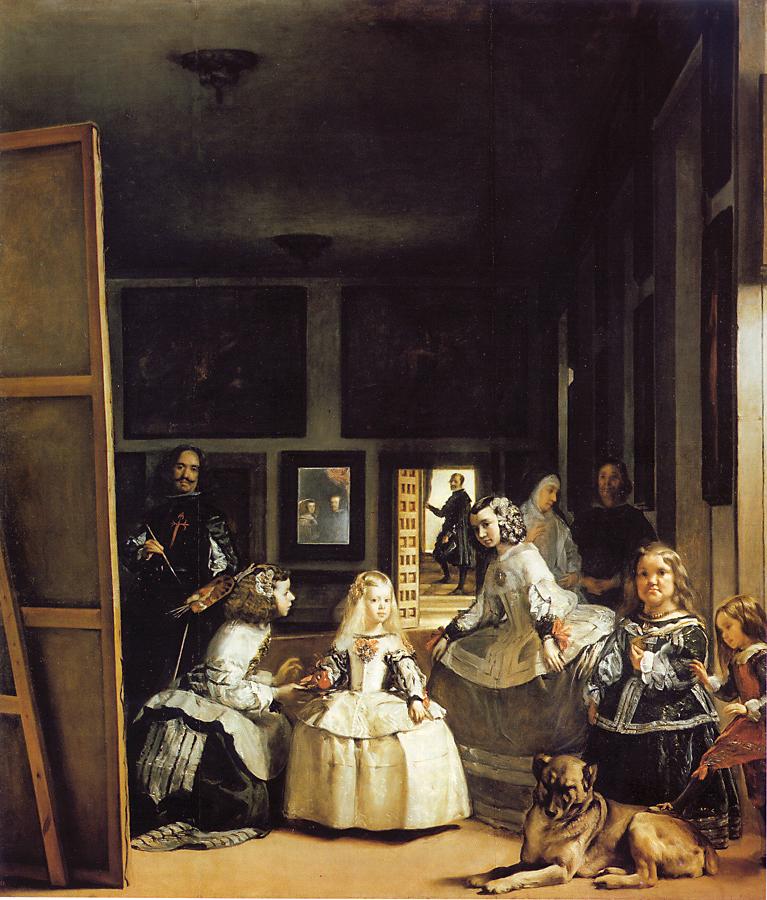
Michel Foucault on Las Meninas
Foucault has an interesting perspective of the Velazquez painting, Las Meninas. It took me a while to understand his two “invisibilities” theory that delves into the author’s creation of perspectives. Everything in the painting is dependent on point-of-view. The audience is denied the image of the models being painted since they are viewing the reverse scene through the eyes of the models. The second invisible is the denial of seeing the front of the canvas that stands in front of the viewer. It is frustrating not being able to know what everyone in the painting is looking at. Left to the viewer’s imagination, it could be anything. But we are given a clue, the mirror in the background. I was unsure at first if the author was going to recognize it as such, but it is an illumination of the invisible characters.
I disagree slightly with his interpretation of the painting’s intended centerpiece. Though I do see the X that he refers to I don’t see the cross or understand it’s meaning. And, how is he able to construe that the attendants are like angels? The child is almost at the center of the picture right below the mirror-image of her parents, the king and queen. Perhaps the painter, Velazquez, was trying to make a point. The original point of the painting, I assume, was supposed to just be the king and queen, since they commissioned it and are the apparent models. But they are the most insignificant and ill-defined characters of the piece. Perhaps it is a representation of a decline in their political importance as they fall into shadow. Their daughter, draped in light and outshining them, is below them in rank but gaining in importance (possibly by political ties, beauty or inheritance, but I am not familiar with the place and time of the setting). All the while, I believe that the models are unsuspecting what the painter is creating on that monstrous canvas, as they pose behind it. They may soon find out because the painter is nearing complete. Foucault notes that the painter holds a “fine brush,” but doesn’t really explain any meaning behind this. Thin brushes are made for small detail work, the last thing to be painted in the process, on top of the background colors. But why would the painter create himself at this stage of painting?
Also, Foucault mentions the man who is behind everything, standing in the stairwell. Technically the painting (the one the viewer sees) should end with the mirror in the background. It sums up everything in the foreground of the painting, and everything between that and it. What is he doing there? The author says that he is as ignored as the mirror and brightly defined in a light of his own. Perhaps he is an objective viewer who is watching over all, shedding light on the situation. To me, he looks like the painter, wearing similar black clothes and mustache/goatee. From this vantage-point, the painter is able not only to review his subjects and their second scene of attendants, but also himself and what he is creating. He is almost studying his own work. He looks out at the audience from the background, judging us and our perceptions as much as we are judging his through his work.
Foucault, Michel. The Order of Things; An Archeaology of the Human Sciences. Pantheon Books: New York. 1970.
Find painting at: http://www.mystudios.com/art/bar/velazquez/velazquez-las-meninas.jpg
I disagree slightly with his interpretation of the painting’s intended centerpiece. Though I do see the X that he refers to I don’t see the cross or understand it’s meaning. And, how is he able to construe that the attendants are like angels? The child is almost at the center of the picture right below the mirror-image of her parents, the king and queen. Perhaps the painter, Velazquez, was trying to make a point. The original point of the painting, I assume, was supposed to just be the king and queen, since they commissioned it and are the apparent models. But they are the most insignificant and ill-defined characters of the piece. Perhaps it is a representation of a decline in their political importance as they fall into shadow. Their daughter, draped in light and outshining them, is below them in rank but gaining in importance (possibly by political ties, beauty or inheritance, but I am not familiar with the place and time of the setting). All the while, I believe that the models are unsuspecting what the painter is creating on that monstrous canvas, as they pose behind it. They may soon find out because the painter is nearing complete. Foucault notes that the painter holds a “fine brush,” but doesn’t really explain any meaning behind this. Thin brushes are made for small detail work, the last thing to be painted in the process, on top of the background colors. But why would the painter create himself at this stage of painting?
Also, Foucault mentions the man who is behind everything, standing in the stairwell. Technically the painting (the one the viewer sees) should end with the mirror in the background. It sums up everything in the foreground of the painting, and everything between that and it. What is he doing there? The author says that he is as ignored as the mirror and brightly defined in a light of his own. Perhaps he is an objective viewer who is watching over all, shedding light on the situation. To me, he looks like the painter, wearing similar black clothes and mustache/goatee. From this vantage-point, the painter is able not only to review his subjects and their second scene of attendants, but also himself and what he is creating. He is almost studying his own work. He looks out at the audience from the background, judging us and our perceptions as much as we are judging his through his work.
Foucault, Michel. The Order of Things; An Archeaology of the Human Sciences. Pantheon Books: New York. 1970.
Find painting at: http://www.mystudios.com/art/bar/velazquez/velazquez-las-meninas.jpg
Monday, September 15, 2008
Darwinistic Literary Criticism?
Darwinstric literary criticism is like a combination of bologna and Swiss cheese: it’s a bunch of compressed God-knows-what with lots of holes in it. First off, it seems that Carroll never heard of Durrell and his views about specialists creating their own vocabulary. Carroll deemed it fit to create “cognitive behavioral system,” “fitness maximization,” and “domain-general intelligence” among others. If I wanted to read VCR instructions, I’d rip them off the back panel of my TV. But, this is beside the point.
Carroll feeds the reader the original model of Darwin Literary Criticism and then proceeds to beat it out of commission and make his own version of it, which is flawed for reasons explained in the Pride and Prejudice section. It does bring up a unique point, though. Characters in books are not humans. Their lives are completely controlled by the author. Therefore they cannot fulfill the basic human requirements that psychologists pinpoint. On the other hand, the author is human and each character is an extension of them so they do have some qualities of true people. If they completely lacked any familiarity with humans then the book would remain unread because the reader would be unable to connect with the story. So, literary characters must have some qualities of humanity though they may not remain true to them and can be largely parodies or exaggerations of human behavior.
This method, as suggested by Carroll, also has the flaw that it has generalized individuality. Not all humans have the same basic instincts and needs that underlie cognitive thought and choice. There is a separation of mind and body, just as Carroll speaks of women being capable of having children and yet choosing not too. It is the same reason that people have sex changes. However it is his argument that people still have the basic instinct to mate, whether it involves children or not. He fails to forget that there are people with no sex drive, or there are people who are attracted to the same sex. Also he states that, on the matter of children, people don’t want to maximize their progeny the way animals do. That is false. There are many religions and cultures that have a high (or normal) sex-drive with the absence of birth control. Also, think of third world countries where people still work the land and need as many bodies as possible, especially with the child death rate being so high. Also, in his little graph of the basic human needs such as kinship, socialization and parenting he neglects to say for what percentage of the population this is true. What of the loners? I’m not referring to the social outcasts but of those who chose to be alone and reclusive or those who abhor human contact. I am one of these and became extremely upset when someone referred to my teaching children in Sunday School as “Mommy training.” She didn’t seem to understand my total refusal of the concept. Look at Timothy Treadwell, he was not made to live with human beings.
Carroll, Joseph. "Human Nature and Literary Meaning: A Theoretical Model Illustrated with a Critique of Pride and Prejudice."
Carroll feeds the reader the original model of Darwin Literary Criticism and then proceeds to beat it out of commission and make his own version of it, which is flawed for reasons explained in the Pride and Prejudice section. It does bring up a unique point, though. Characters in books are not humans. Their lives are completely controlled by the author. Therefore they cannot fulfill the basic human requirements that psychologists pinpoint. On the other hand, the author is human and each character is an extension of them so they do have some qualities of true people. If they completely lacked any familiarity with humans then the book would remain unread because the reader would be unable to connect with the story. So, literary characters must have some qualities of humanity though they may not remain true to them and can be largely parodies or exaggerations of human behavior.
This method, as suggested by Carroll, also has the flaw that it has generalized individuality. Not all humans have the same basic instincts and needs that underlie cognitive thought and choice. There is a separation of mind and body, just as Carroll speaks of women being capable of having children and yet choosing not too. It is the same reason that people have sex changes. However it is his argument that people still have the basic instinct to mate, whether it involves children or not. He fails to forget that there are people with no sex drive, or there are people who are attracted to the same sex. Also he states that, on the matter of children, people don’t want to maximize their progeny the way animals do. That is false. There are many religions and cultures that have a high (or normal) sex-drive with the absence of birth control. Also, think of third world countries where people still work the land and need as many bodies as possible, especially with the child death rate being so high. Also, in his little graph of the basic human needs such as kinship, socialization and parenting he neglects to say for what percentage of the population this is true. What of the loners? I’m not referring to the social outcasts but of those who chose to be alone and reclusive or those who abhor human contact. I am one of these and became extremely upset when someone referred to my teaching children in Sunday School as “Mommy training.” She didn’t seem to understand my total refusal of the concept. Look at Timothy Treadwell, he was not made to live with human beings.
Carroll, Joseph. "Human Nature and Literary Meaning: A Theoretical Model Illustrated with a Critique of Pride and Prejudice."
Carroll’s Model: Is an unsatisfactory account of Pride and Prejudice
Carroll’s analytical version of Pride and Prejudice follows more an account of the movie version than the actual book, leaving out nuances of character-building meeting between Darcy and Elizabeth such as the scene where she refuses to dance with him. As well, Carroll seems to completely ignore the historical precedent of the storyline when forming his assumptions of character behavior and of the author. For instance, he says that, basically, Miss de Bourgh is thrown to the wolves at the bottom of the social hierarchy without the characters and the author feeling any pity for her diminished mental state. What Carroll is failing to realize is that at that point in history, people with mental illness (most likely autism or mental retardation in Miss de Bourgh’s case) were permanently put away either in an institution, or, more likely, someone’s attic or closet for the entirety of their lives. Miss de Bourgh earns no pity because the privilege of her birth has saved her from such a wretched life and can be thinly passed off as “normal” by her mother to the general public. In fact, her life, even as secluded as it is, is to far better standards than what Elizabeth lives at. It’s little details like this that are undermining Carroll’s critique attempting to compare the characters to real-life humans.
Also, Carroll is still stuck on the “evolutionary psychology” aspect of criticizing humans, something he warns against doing at the beginning of the article. He keeps referring to the fact that all people are mainly seeking resources and mates, especially in Pride and Prejudice. This may be true for most Cro-Magnons and baboons, but not all people are gold-diggers or nymphomaniacs. The thing that people are most likely seeking, especially in this book, is social status. Social status is considered by some to increase or create the realization of self (Maslow’s Hierarchy of Needs). Really, it just increases a person’s adaptability into a social group or culture to create a sense of belonging. Truly, all the women in this novel are insecure. Mrs. Bennett fears belittlement by her neighbors with an embarrassment of unwed daughters. The daughters are unsure about their future since they are unable to hold property and it would be demeaning to work according to their social customs. They are all seeking security by increasing their social status. Lydia, even though her marriage doesn’t bring much “property” still gives her the added advantage of now being married (an adult) as exemplified when she showed off her ring to a local girl in town. But, males also marry to gain status among other males (the authority figures at the time). Carroll says that men gain resources in order to attract a mate. However, men then and now still gain resources to show off to other men and women, especially then, can be property. If you have the most gorgeous woman in the county on your arm at a ball it is to flaunt her to the other men perhaps claiming greater sexual prowess, charm, etc. Carroll’s view is definitely flawed.
Carroll, Joseph. "Human Nature and Literary Meaning: A Theoretical Model Illustrated with a Critique of Pride and Prejudice."
Also, Carroll is still stuck on the “evolutionary psychology” aspect of criticizing humans, something he warns against doing at the beginning of the article. He keeps referring to the fact that all people are mainly seeking resources and mates, especially in Pride and Prejudice. This may be true for most Cro-Magnons and baboons, but not all people are gold-diggers or nymphomaniacs. The thing that people are most likely seeking, especially in this book, is social status. Social status is considered by some to increase or create the realization of self (Maslow’s Hierarchy of Needs). Really, it just increases a person’s adaptability into a social group or culture to create a sense of belonging. Truly, all the women in this novel are insecure. Mrs. Bennett fears belittlement by her neighbors with an embarrassment of unwed daughters. The daughters are unsure about their future since they are unable to hold property and it would be demeaning to work according to their social customs. They are all seeking security by increasing their social status. Lydia, even though her marriage doesn’t bring much “property” still gives her the added advantage of now being married (an adult) as exemplified when she showed off her ring to a local girl in town. But, males also marry to gain status among other males (the authority figures at the time). Carroll says that men gain resources in order to attract a mate. However, men then and now still gain resources to show off to other men and women, especially then, can be property. If you have the most gorgeous woman in the county on your arm at a ball it is to flaunt her to the other men perhaps claiming greater sexual prowess, charm, etc. Carroll’s view is definitely flawed.
Carroll, Joseph. "Human Nature and Literary Meaning: A Theoretical Model Illustrated with a Critique of Pride and Prejudice."
Monday, September 8, 2008
The Story of Philosophy
Durant, in The Story of Philosophy, is almost reverent in his defense of philosophy. Instead of juxtaposing it to science, as he claims many scholars do, he states that philosophy is the foundation of science. Philosophy encompasses all that is studied that is not yet substantiated or proven with fact. Philosophy has always been considered the realm of contemplation and “wisdom,” but can we truly believe that science is born of philosophy?
According to Durant, science is a narrow-minded world; that people are now learning “’more and more about less and less’” (Durant, 5). He compared it to a person who is absorbed with the leg of an insect and not the being itself. Philosophy is supposed to encompass the insect, its life, its habits, its niche. Though, if this is true to his lips, I would beg to differ. Perhaps science and philosophy are two roads that run parallel and yet are on different planes. But, for Durant, philosophy is the origin of thought and humanity. He speaks often of bringing humanity to knowledge. Philosophy through scholastic discourse is the solution to the stuffy and uptight teachings of science, history and other such subjects that have been trapped in the specialist jargon. There is no denial that lessons that do not read like VCR instructions entertain and engage the reader. However, Durant at least warns about falling into folly of being so light on your words as to skip the essentials of the lesson, such as The Story of Religion. He even has the grace to criticize his first edition of The Story of Philosophy for taking the breadth of philosophy lightly. However, Durant finds the gem of knowledge in “outlines” that may give the reader the general knowledge to survive while still being able to view the larger picture, keeping in tune with the belief of philosophy rather than the drills of science.
Durant, Will. The Story of Philosophy. Simon and Schuster: New York, 1961.
According to Durant, science is a narrow-minded world; that people are now learning “’more and more about less and less’” (Durant, 5). He compared it to a person who is absorbed with the leg of an insect and not the being itself. Philosophy is supposed to encompass the insect, its life, its habits, its niche. Though, if this is true to his lips, I would beg to differ. Perhaps science and philosophy are two roads that run parallel and yet are on different planes. But, for Durant, philosophy is the origin of thought and humanity. He speaks often of bringing humanity to knowledge. Philosophy through scholastic discourse is the solution to the stuffy and uptight teachings of science, history and other such subjects that have been trapped in the specialist jargon. There is no denial that lessons that do not read like VCR instructions entertain and engage the reader. However, Durant at least warns about falling into folly of being so light on your words as to skip the essentials of the lesson, such as The Story of Religion. He even has the grace to criticize his first edition of The Story of Philosophy for taking the breadth of philosophy lightly. However, Durant finds the gem of knowledge in “outlines” that may give the reader the general knowledge to survive while still being able to view the larger picture, keeping in tune with the belief of philosophy rather than the drills of science.
Durant, Will. The Story of Philosophy. Simon and Schuster: New York, 1961.
Pride and Prejudice: Mr. Collins
Mr. Collins serves as a very interesting character that is the perfect example of vanity. Mr. Collins, though of lowly background, still is quick to look down upon others from his quickly gained position as a clergyman (usually a bought position at the time) under his much brown-nosed patroness. His constant name-dropping as well as constant mentioning of prices and quality that surround him are vain attempts to fluff his own feathers and be the cock of the henhouse. This lies in direct contrast with his supposedly “humble” position. There is not a pious bone in that man’s body. And yet, with anyone of great standing in society, whether they be noble or rich, he is quick to ingrate himself and downplay his lot in life as quickly as he is to augment it in the company of commoners. In this, Mr. Collins represents that person that the nobility seem to fear, the gold-digger so to speak. For example, Mrs. DeBourgh and other ladies in society fear that Elizabeth is such a person of lowly circumstance who is just trying to climb the social ladder through Mr. Darcy.
Mr. Collins is also a great sexist, the typical male visionary expected at the time. When he tries to read the sermons at the Bennett house but is interrupted by Lydia, he gives up on the women as interested in no useful knowledge, only their feminine trifles. Indeed, the women do seem rather dull and ditsy from a modern perspective, but Elizabeth has the wit beyond all of them. Besides being a novel of romance, Pride and Prejudice attempts to push some feminist ideals. While most women were a slab of meat to be purchased at the butchers shop, Elizabeth attracts Darcy with her off-the-wall personality and cleverness. She is not the greatest beauty in the world but, to him, that doesn’t matter. Darcy is the anti-Collins. Reserved where he is boastful. Genuine where he is false. Perceptive where he is, well, just plain stupid and tactless. Collins is the best character to highlight the pleasant qualities that Darcy has to show.
Mr. Collins is also a great sexist, the typical male visionary expected at the time. When he tries to read the sermons at the Bennett house but is interrupted by Lydia, he gives up on the women as interested in no useful knowledge, only their feminine trifles. Indeed, the women do seem rather dull and ditsy from a modern perspective, but Elizabeth has the wit beyond all of them. Besides being a novel of romance, Pride and Prejudice attempts to push some feminist ideals. While most women were a slab of meat to be purchased at the butchers shop, Elizabeth attracts Darcy with her off-the-wall personality and cleverness. She is not the greatest beauty in the world but, to him, that doesn’t matter. Darcy is the anti-Collins. Reserved where he is boastful. Genuine where he is false. Perceptive where he is, well, just plain stupid and tactless. Collins is the best character to highlight the pleasant qualities that Darcy has to show.
Subscribe to:
Posts (Atom)