


The Third of May, by Francisco de Goya, is a very striking piece that conjures a story rather than being just an eye-pleasing photo. The scene is violent and intimidating with unarmed men cowering in front of a firing squad. But their dress, they are in an older time, during one of war or uprising. Most likely the latter because it is not a pose of soldier against soldier. The men with the guns are in battle gear, their guns in their arms, provisions on their backs and a saber at their sides. The people before them are in plain clothes, less neat and rudimentary as-if hand-made. Added to the sense of martyrdom is the pose of the illuminated man in the white and tan. He is almost Christ-like with his arms stretched out in supplication. The man fallen beside him is in a similar pose. Then, in the opposition of light and dark, created by overly-large lantern, the man in tan is cast in light while the soldiers are in the dark. The division of light and dark splits almost down the middle, creating an unnatural display of light for the lantern which should cast light in all directions.
The martyr and his people are also resting on a small rise in the landscape, raising them above the cowering crowd and at face-level with the soldiers, even though the victims are on their knees. Behind them rests a church with its bell tower and stain glass window. But everyone is outside, partially hidden from it by a small hillock, and the faces of the killers are hidden in the shadow and light, turned away from the audience. Many members of the crowd also have their faces covered. This is possibly a sign that this act is being hidden from the eyes of God/justice. The heavens are not even visible.. The stars and satellite are hidden by clouds. The only light offered is that made by the government (soldiers), representing that they control the situation and that they are the ones to see the “truth” of the situation. The soldiers are blinded by the light.
There is definitely a narrative created by the “artistic vocabulary” of the painting. Even without the background information of the piece, the audience can still discern some of the intent of the painter by analyzing the symbolism in their technique. In The Third of May, the soldiers are portrayed in an unfavorable light. Here, they are the evildoers and the citizens are the heroes, willing to die for their people.
Monday, September 22, 2008

Michel Foucault on Las Meninas
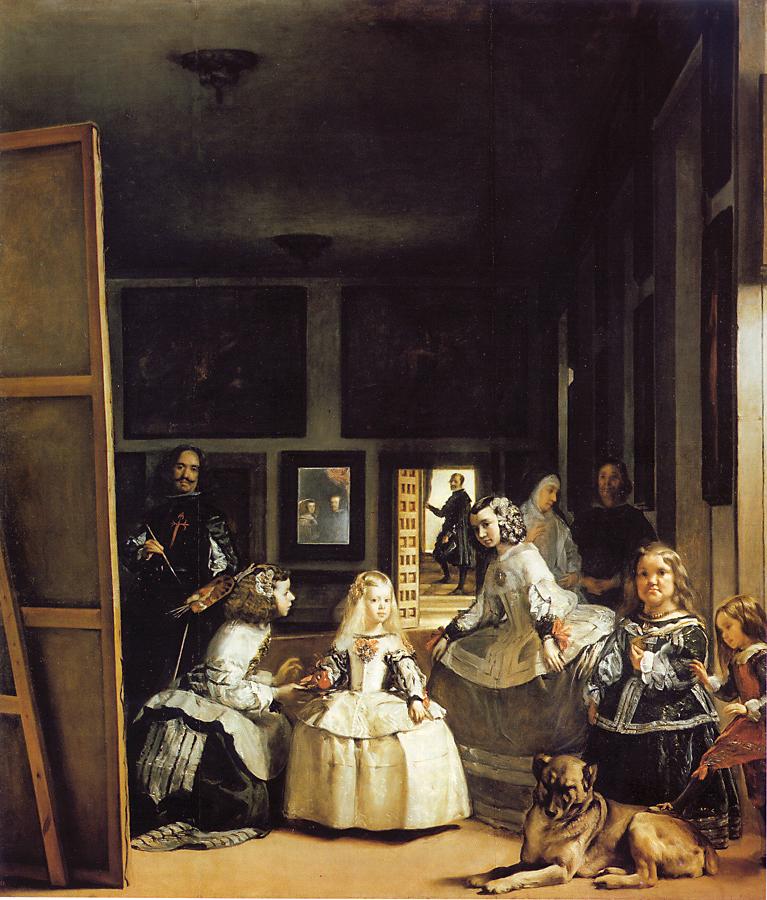
Foucault has an interesting perspective of the Velazquez painting, Las Meninas. It took me a while to understand his two “invisibilities” theory that delves into the author’s creation of perspectives. Everything in the painting is dependent on point-of-view. The audience is denied the image of the models being painted since they are viewing the reverse scene through the eyes of the models. The second invisible is the denial of seeing the front of the canvas that stands in front of the viewer. It is frustrating not being able to know what everyone in the painting is looking at. Left to the viewer’s imagination, it could be anything. But we are given a clue, the mirror in the background. I was unsure at first if the author was going to recognize it as such, but it is an illumination of the invisible characters.
I disagree slightly with his interpretation of the painting’s intended centerpiece. Though I do see the X that he refers to I don’t see the cross or understand it’s meaning. And, how is he able to construe that the attendants are like angels? The child is almost at the center of the picture right below the mirror-image of her parents, the king and queen. Perhaps the painter, Velazquez, was trying to make a point. The original point of the painting, I assume, was supposed to just be the king and queen, since they commissioned it and are the apparent models. But they are the most insignificant and ill-defined characters of the piece. Perhaps it is a representation of a decline in their political importance as they fall into shadow. Their daughter, draped in light and outshining them, is below them in rank but gaining in importance (possibly by political ties, beauty or inheritance, but I am not familiar with the place and time of the setting). All the while, I believe that the models are unsuspecting what the painter is creating on that monstrous canvas, as they pose behind it. They may soon find out because the painter is nearing complete. Foucault notes that the painter holds a “fine brush,” but doesn’t really explain any meaning behind this. Thin brushes are made for small detail work, the last thing to be painted in the process, on top of the background colors. But why would the painter create himself at this stage of painting?
Also, Foucault mentions the man who is behind everything, standing in the stairwell. Technically the painting (the one the viewer sees) should end with the mirror in the background. It sums up everything in the foreground of the painting, and everything between that and it. What is he doing there? The author says that he is as ignored as the mirror and brightly defined in a light of his own. Perhaps he is an objective viewer who is watching over all, shedding light on the situation. To me, he looks like the painter, wearing similar black clothes and mustache/goatee. From this vantage-point, the painter is able not only to review his subjects and their second scene of attendants, but also himself and what he is creating. He is almost studying his own work. He looks out at the audience from the background, judging us and our perceptions as much as we are judging his through his work.
Foucault, Michel. The Order of Things; An Archeaology of the Human Sciences. Pantheon Books: New York. 1970.
Find painting at: http://www.mystudios.com/art/bar/velazquez/velazquez-las-meninas.jpg
I disagree slightly with his interpretation of the painting’s intended centerpiece. Though I do see the X that he refers to I don’t see the cross or understand it’s meaning. And, how is he able to construe that the attendants are like angels? The child is almost at the center of the picture right below the mirror-image of her parents, the king and queen. Perhaps the painter, Velazquez, was trying to make a point. The original point of the painting, I assume, was supposed to just be the king and queen, since they commissioned it and are the apparent models. But they are the most insignificant and ill-defined characters of the piece. Perhaps it is a representation of a decline in their political importance as they fall into shadow. Their daughter, draped in light and outshining them, is below them in rank but gaining in importance (possibly by political ties, beauty or inheritance, but I am not familiar with the place and time of the setting). All the while, I believe that the models are unsuspecting what the painter is creating on that monstrous canvas, as they pose behind it. They may soon find out because the painter is nearing complete. Foucault notes that the painter holds a “fine brush,” but doesn’t really explain any meaning behind this. Thin brushes are made for small detail work, the last thing to be painted in the process, on top of the background colors. But why would the painter create himself at this stage of painting?
Also, Foucault mentions the man who is behind everything, standing in the stairwell. Technically the painting (the one the viewer sees) should end with the mirror in the background. It sums up everything in the foreground of the painting, and everything between that and it. What is he doing there? The author says that he is as ignored as the mirror and brightly defined in a light of his own. Perhaps he is an objective viewer who is watching over all, shedding light on the situation. To me, he looks like the painter, wearing similar black clothes and mustache/goatee. From this vantage-point, the painter is able not only to review his subjects and their second scene of attendants, but also himself and what he is creating. He is almost studying his own work. He looks out at the audience from the background, judging us and our perceptions as much as we are judging his through his work.
Foucault, Michel. The Order of Things; An Archeaology of the Human Sciences. Pantheon Books: New York. 1970.
Find painting at: http://www.mystudios.com/art/bar/velazquez/velazquez-las-meninas.jpg
Monday, September 15, 2008
Darwinistic Literary Criticism?
Darwinstric literary criticism is like a combination of bologna and Swiss cheese: it’s a bunch of compressed God-knows-what with lots of holes in it. First off, it seems that Carroll never heard of Durrell and his views about specialists creating their own vocabulary. Carroll deemed it fit to create “cognitive behavioral system,” “fitness maximization,” and “domain-general intelligence” among others. If I wanted to read VCR instructions, I’d rip them off the back panel of my TV. But, this is beside the point.
Carroll feeds the reader the original model of Darwin Literary Criticism and then proceeds to beat it out of commission and make his own version of it, which is flawed for reasons explained in the Pride and Prejudice section. It does bring up a unique point, though. Characters in books are not humans. Their lives are completely controlled by the author. Therefore they cannot fulfill the basic human requirements that psychologists pinpoint. On the other hand, the author is human and each character is an extension of them so they do have some qualities of true people. If they completely lacked any familiarity with humans then the book would remain unread because the reader would be unable to connect with the story. So, literary characters must have some qualities of humanity though they may not remain true to them and can be largely parodies or exaggerations of human behavior.
This method, as suggested by Carroll, also has the flaw that it has generalized individuality. Not all humans have the same basic instincts and needs that underlie cognitive thought and choice. There is a separation of mind and body, just as Carroll speaks of women being capable of having children and yet choosing not too. It is the same reason that people have sex changes. However it is his argument that people still have the basic instinct to mate, whether it involves children or not. He fails to forget that there are people with no sex drive, or there are people who are attracted to the same sex. Also he states that, on the matter of children, people don’t want to maximize their progeny the way animals do. That is false. There are many religions and cultures that have a high (or normal) sex-drive with the absence of birth control. Also, think of third world countries where people still work the land and need as many bodies as possible, especially with the child death rate being so high. Also, in his little graph of the basic human needs such as kinship, socialization and parenting he neglects to say for what percentage of the population this is true. What of the loners? I’m not referring to the social outcasts but of those who chose to be alone and reclusive or those who abhor human contact. I am one of these and became extremely upset when someone referred to my teaching children in Sunday School as “Mommy training.” She didn’t seem to understand my total refusal of the concept. Look at Timothy Treadwell, he was not made to live with human beings.
Carroll, Joseph. "Human Nature and Literary Meaning: A Theoretical Model Illustrated with a Critique of Pride and Prejudice."
Carroll feeds the reader the original model of Darwin Literary Criticism and then proceeds to beat it out of commission and make his own version of it, which is flawed for reasons explained in the Pride and Prejudice section. It does bring up a unique point, though. Characters in books are not humans. Their lives are completely controlled by the author. Therefore they cannot fulfill the basic human requirements that psychologists pinpoint. On the other hand, the author is human and each character is an extension of them so they do have some qualities of true people. If they completely lacked any familiarity with humans then the book would remain unread because the reader would be unable to connect with the story. So, literary characters must have some qualities of humanity though they may not remain true to them and can be largely parodies or exaggerations of human behavior.
This method, as suggested by Carroll, also has the flaw that it has generalized individuality. Not all humans have the same basic instincts and needs that underlie cognitive thought and choice. There is a separation of mind and body, just as Carroll speaks of women being capable of having children and yet choosing not too. It is the same reason that people have sex changes. However it is his argument that people still have the basic instinct to mate, whether it involves children or not. He fails to forget that there are people with no sex drive, or there are people who are attracted to the same sex. Also he states that, on the matter of children, people don’t want to maximize their progeny the way animals do. That is false. There are many religions and cultures that have a high (or normal) sex-drive with the absence of birth control. Also, think of third world countries where people still work the land and need as many bodies as possible, especially with the child death rate being so high. Also, in his little graph of the basic human needs such as kinship, socialization and parenting he neglects to say for what percentage of the population this is true. What of the loners? I’m not referring to the social outcasts but of those who chose to be alone and reclusive or those who abhor human contact. I am one of these and became extremely upset when someone referred to my teaching children in Sunday School as “Mommy training.” She didn’t seem to understand my total refusal of the concept. Look at Timothy Treadwell, he was not made to live with human beings.
Carroll, Joseph. "Human Nature and Literary Meaning: A Theoretical Model Illustrated with a Critique of Pride and Prejudice."
Carroll’s Model: Is an unsatisfactory account of Pride and Prejudice
Carroll’s analytical version of Pride and Prejudice follows more an account of the movie version than the actual book, leaving out nuances of character-building meeting between Darcy and Elizabeth such as the scene where she refuses to dance with him. As well, Carroll seems to completely ignore the historical precedent of the storyline when forming his assumptions of character behavior and of the author. For instance, he says that, basically, Miss de Bourgh is thrown to the wolves at the bottom of the social hierarchy without the characters and the author feeling any pity for her diminished mental state. What Carroll is failing to realize is that at that point in history, people with mental illness (most likely autism or mental retardation in Miss de Bourgh’s case) were permanently put away either in an institution, or, more likely, someone’s attic or closet for the entirety of their lives. Miss de Bourgh earns no pity because the privilege of her birth has saved her from such a wretched life and can be thinly passed off as “normal” by her mother to the general public. In fact, her life, even as secluded as it is, is to far better standards than what Elizabeth lives at. It’s little details like this that are undermining Carroll’s critique attempting to compare the characters to real-life humans.
Also, Carroll is still stuck on the “evolutionary psychology” aspect of criticizing humans, something he warns against doing at the beginning of the article. He keeps referring to the fact that all people are mainly seeking resources and mates, especially in Pride and Prejudice. This may be true for most Cro-Magnons and baboons, but not all people are gold-diggers or nymphomaniacs. The thing that people are most likely seeking, especially in this book, is social status. Social status is considered by some to increase or create the realization of self (Maslow’s Hierarchy of Needs). Really, it just increases a person’s adaptability into a social group or culture to create a sense of belonging. Truly, all the women in this novel are insecure. Mrs. Bennett fears belittlement by her neighbors with an embarrassment of unwed daughters. The daughters are unsure about their future since they are unable to hold property and it would be demeaning to work according to their social customs. They are all seeking security by increasing their social status. Lydia, even though her marriage doesn’t bring much “property” still gives her the added advantage of now being married (an adult) as exemplified when she showed off her ring to a local girl in town. But, males also marry to gain status among other males (the authority figures at the time). Carroll says that men gain resources in order to attract a mate. However, men then and now still gain resources to show off to other men and women, especially then, can be property. If you have the most gorgeous woman in the county on your arm at a ball it is to flaunt her to the other men perhaps claiming greater sexual prowess, charm, etc. Carroll’s view is definitely flawed.
Carroll, Joseph. "Human Nature and Literary Meaning: A Theoretical Model Illustrated with a Critique of Pride and Prejudice."
Also, Carroll is still stuck on the “evolutionary psychology” aspect of criticizing humans, something he warns against doing at the beginning of the article. He keeps referring to the fact that all people are mainly seeking resources and mates, especially in Pride and Prejudice. This may be true for most Cro-Magnons and baboons, but not all people are gold-diggers or nymphomaniacs. The thing that people are most likely seeking, especially in this book, is social status. Social status is considered by some to increase or create the realization of self (Maslow’s Hierarchy of Needs). Really, it just increases a person’s adaptability into a social group or culture to create a sense of belonging. Truly, all the women in this novel are insecure. Mrs. Bennett fears belittlement by her neighbors with an embarrassment of unwed daughters. The daughters are unsure about their future since they are unable to hold property and it would be demeaning to work according to their social customs. They are all seeking security by increasing their social status. Lydia, even though her marriage doesn’t bring much “property” still gives her the added advantage of now being married (an adult) as exemplified when she showed off her ring to a local girl in town. But, males also marry to gain status among other males (the authority figures at the time). Carroll says that men gain resources in order to attract a mate. However, men then and now still gain resources to show off to other men and women, especially then, can be property. If you have the most gorgeous woman in the county on your arm at a ball it is to flaunt her to the other men perhaps claiming greater sexual prowess, charm, etc. Carroll’s view is definitely flawed.
Carroll, Joseph. "Human Nature and Literary Meaning: A Theoretical Model Illustrated with a Critique of Pride and Prejudice."
Monday, September 8, 2008
The Story of Philosophy
Durant, in The Story of Philosophy, is almost reverent in his defense of philosophy. Instead of juxtaposing it to science, as he claims many scholars do, he states that philosophy is the foundation of science. Philosophy encompasses all that is studied that is not yet substantiated or proven with fact. Philosophy has always been considered the realm of contemplation and “wisdom,” but can we truly believe that science is born of philosophy?
According to Durant, science is a narrow-minded world; that people are now learning “’more and more about less and less’” (Durant, 5). He compared it to a person who is absorbed with the leg of an insect and not the being itself. Philosophy is supposed to encompass the insect, its life, its habits, its niche. Though, if this is true to his lips, I would beg to differ. Perhaps science and philosophy are two roads that run parallel and yet are on different planes. But, for Durant, philosophy is the origin of thought and humanity. He speaks often of bringing humanity to knowledge. Philosophy through scholastic discourse is the solution to the stuffy and uptight teachings of science, history and other such subjects that have been trapped in the specialist jargon. There is no denial that lessons that do not read like VCR instructions entertain and engage the reader. However, Durant at least warns about falling into folly of being so light on your words as to skip the essentials of the lesson, such as The Story of Religion. He even has the grace to criticize his first edition of The Story of Philosophy for taking the breadth of philosophy lightly. However, Durant finds the gem of knowledge in “outlines” that may give the reader the general knowledge to survive while still being able to view the larger picture, keeping in tune with the belief of philosophy rather than the drills of science.
Durant, Will. The Story of Philosophy. Simon and Schuster: New York, 1961.
According to Durant, science is a narrow-minded world; that people are now learning “’more and more about less and less’” (Durant, 5). He compared it to a person who is absorbed with the leg of an insect and not the being itself. Philosophy is supposed to encompass the insect, its life, its habits, its niche. Though, if this is true to his lips, I would beg to differ. Perhaps science and philosophy are two roads that run parallel and yet are on different planes. But, for Durant, philosophy is the origin of thought and humanity. He speaks often of bringing humanity to knowledge. Philosophy through scholastic discourse is the solution to the stuffy and uptight teachings of science, history and other such subjects that have been trapped in the specialist jargon. There is no denial that lessons that do not read like VCR instructions entertain and engage the reader. However, Durant at least warns about falling into folly of being so light on your words as to skip the essentials of the lesson, such as The Story of Religion. He even has the grace to criticize his first edition of The Story of Philosophy for taking the breadth of philosophy lightly. However, Durant finds the gem of knowledge in “outlines” that may give the reader the general knowledge to survive while still being able to view the larger picture, keeping in tune with the belief of philosophy rather than the drills of science.
Durant, Will. The Story of Philosophy. Simon and Schuster: New York, 1961.
Pride and Prejudice: Mr. Collins
Mr. Collins serves as a very interesting character that is the perfect example of vanity. Mr. Collins, though of lowly background, still is quick to look down upon others from his quickly gained position as a clergyman (usually a bought position at the time) under his much brown-nosed patroness. His constant name-dropping as well as constant mentioning of prices and quality that surround him are vain attempts to fluff his own feathers and be the cock of the henhouse. This lies in direct contrast with his supposedly “humble” position. There is not a pious bone in that man’s body. And yet, with anyone of great standing in society, whether they be noble or rich, he is quick to ingrate himself and downplay his lot in life as quickly as he is to augment it in the company of commoners. In this, Mr. Collins represents that person that the nobility seem to fear, the gold-digger so to speak. For example, Mrs. DeBourgh and other ladies in society fear that Elizabeth is such a person of lowly circumstance who is just trying to climb the social ladder through Mr. Darcy.
Mr. Collins is also a great sexist, the typical male visionary expected at the time. When he tries to read the sermons at the Bennett house but is interrupted by Lydia, he gives up on the women as interested in no useful knowledge, only their feminine trifles. Indeed, the women do seem rather dull and ditsy from a modern perspective, but Elizabeth has the wit beyond all of them. Besides being a novel of romance, Pride and Prejudice attempts to push some feminist ideals. While most women were a slab of meat to be purchased at the butchers shop, Elizabeth attracts Darcy with her off-the-wall personality and cleverness. She is not the greatest beauty in the world but, to him, that doesn’t matter. Darcy is the anti-Collins. Reserved where he is boastful. Genuine where he is false. Perceptive where he is, well, just plain stupid and tactless. Collins is the best character to highlight the pleasant qualities that Darcy has to show.
Mr. Collins is also a great sexist, the typical male visionary expected at the time. When he tries to read the sermons at the Bennett house but is interrupted by Lydia, he gives up on the women as interested in no useful knowledge, only their feminine trifles. Indeed, the women do seem rather dull and ditsy from a modern perspective, but Elizabeth has the wit beyond all of them. Besides being a novel of romance, Pride and Prejudice attempts to push some feminist ideals. While most women were a slab of meat to be purchased at the butchers shop, Elizabeth attracts Darcy with her off-the-wall personality and cleverness. She is not the greatest beauty in the world but, to him, that doesn’t matter. Darcy is the anti-Collins. Reserved where he is boastful. Genuine where he is false. Perceptive where he is, well, just plain stupid and tactless. Collins is the best character to highlight the pleasant qualities that Darcy has to show.
Subscribe to:
Posts (Atom)