


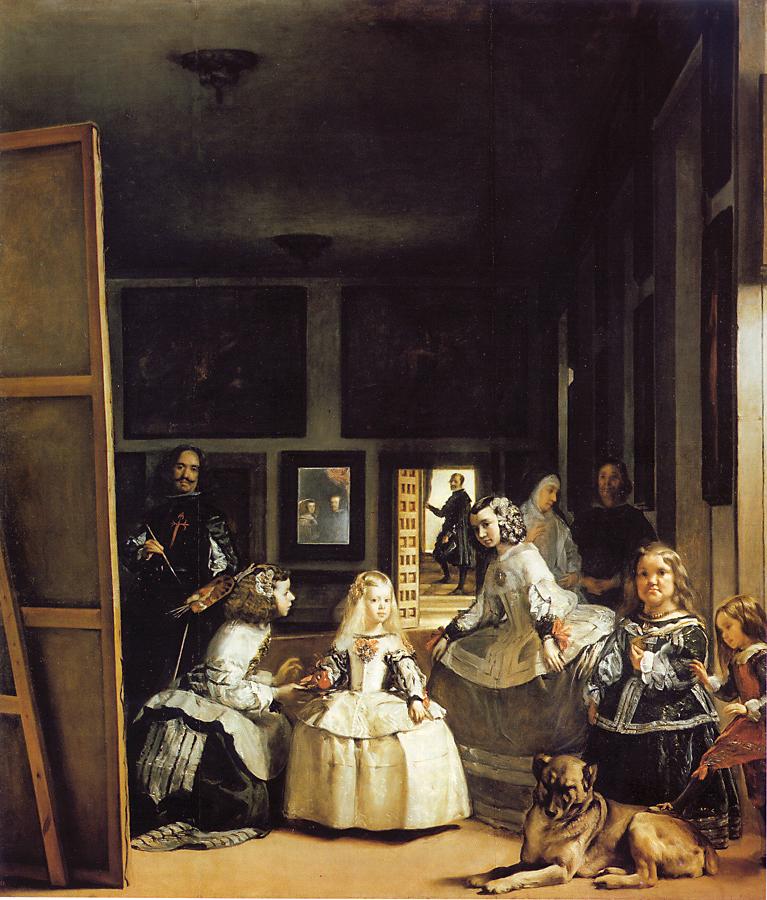
Foucault has an interesting perspective of the Velazquez painting, Las Meninas. It took me a while to understand his two “invisibilities” theory that delves into the author’s creation of perspectives. Everything in the painting is dependent on point-of-view. The audience is denied the image of the models being painted since they are viewing the reverse scene through the eyes of the models. The second invisible is the denial of seeing the front of the canvas that stands in front of the viewer. It is frustrating not being able to know what everyone in the painting is looking at. Left to the viewer’s imagination, it could be anything. But we are given a clue, the mirror in the background. I was unsure at first if the author was going to recognize it as such, but it is an illumination of the invisible characters.
I disagree slightly with his interpretation of the painting’s intended centerpiece. Though I do see the X that he refers to I don’t see the cross or understand it’s meaning. And, how is he able to construe that the attendants are like angels? The child is almost at the center of the picture right below the mirror-image of her parents, the king and queen. Perhaps the painter, Velazquez, was trying to make a point. The original point of the painting, I assume, was supposed to just be the king and queen, since they commissioned it and are the apparent models. But they are the most insignificant and ill-defined characters of the piece. Perhaps it is a representation of a decline in their political importance as they fall into shadow. Their daughter, draped in light and outshining them, is below them in rank but gaining in importance (possibly by political ties, beauty or inheritance, but I am not familiar with the place and time of the setting). All the while, I believe that the models are unsuspecting what the painter is creating on that monstrous canvas, as they pose behind it. They may soon find out because the painter is nearing complete. Foucault notes that the painter holds a “fine brush,” but doesn’t really explain any meaning behind this. Thin brushes are made for small detail work, the last thing to be painted in the process, on top of the background colors. But why would the painter create himself at this stage of painting?
Also, Foucault mentions the man who is behind everything, standing in the stairwell. Technically the painting (the one the viewer sees) should end with the mirror in the background. It sums up everything in the foreground of the painting, and everything between that and it. What is he doing there? The author says that he is as ignored as the mirror and brightly defined in a light of his own. Perhaps he is an objective viewer who is watching over all, shedding light on the situation. To me, he looks like the painter, wearing similar black clothes and mustache/goatee. From this vantage-point, the painter is able not only to review his subjects and their second scene of attendants, but also himself and what he is creating. He is almost studying his own work. He looks out at the audience from the background, judging us and our perceptions as much as we are judging his through his work.
Foucault, Michel. The Order of Things; An Archeaology of the Human Sciences. Pantheon Books: New York. 1970.
Find painting at: http://www.mystudios.com/art/bar/velazquez/velazquez-las-meninas.jpg

Subscribe to:
Post Comments (Atom)
1 comment:
Interesting suggestion, Rebecca: "To me, he looks like the painter, wearing similar black clothes and mustache/goatee. From this vantage-point, the painter is able not only to review his subjects and their second scene of attendants, but also himself and what he is creating. He is almost studying his own work. He looks out at the audience from the background, judging us and our perceptions as much as we are judging his through his work." - even though I tend to think of him as some unnamed individual gazing at the scene, not Velazquez.
ka
Post a Comment